Thomas asks
what might lie beyond the wish to restore what was: a meaning or possibility you could not have seen before. It cannot be planned in advance.
The Book Riga, 2026
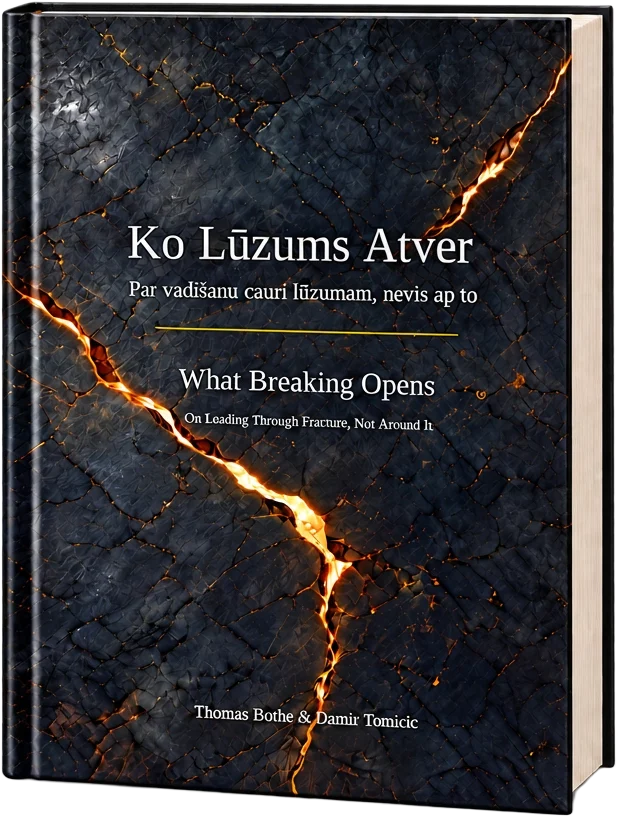
Ko lūzums atver. On leading through fracture, not around it.
For thirty years I spoke about what worked. This book is about what didn’t: the decisions I got wrong, and what it took to keep leading after them. I wrote it with Thomas Bothe, a man who questioned me where I was used to being certain.
It is a bilingual hardcover. English on the left-hand page, Latvian on the right. You can follow a thought in both languages and notice how its shade changes.
Pre-orders are open. The first copies are planned for late November 2026.
A decision has been made. The team has a plan. People know what needs to happen next. And yet one conversation keeps returning. Perhaps the bad news has become too polite. Perhaps the words everyone uses to describe what happened no longer quite fit. The work continues, but something has cracked.
I have seen this in teams I led. I have heard it from clients. I recognise it in my own life. You don’t have to decide yet what it means.
The work begins by not walking past what the crack reveals.
How it started
I was preparing a talk about mistakes. For thirty years I had spoken around the world about success, innovation and the future. This time the organisers asked me to do the opposite. When I sat down to write, nothing came.
The answer had been in my room all along: a small kintsugi bowl. The cracks were my mistakes. The gold was what I did with them.
What if the crack is where your leadership begins?
When Thomas first heard that keynote, he was cautious about the metaphor. He wondered whether the kintsugi image could become a beautiful frame for stories that move people but lead to no real change. Could we speak honestly about breaking, even when it does not make us look better? Could a leadership team hear bad news before it is softened into words that trouble no one?
We talked, disagreed and kept the conversation going. Nobody rushed to agree. Out of that exchange grew this book.
Olga Roze translated the book into Latvian while her own family was coming apart. The book became an ally as she went through her own breaking. What mattered to her was hearing what remains between the words, and letting Thomas and me sound like ourselves in another language.
When something breaks, the first wish is often to repair it: to restore a relationship, a team, the trust you once had in yourself. To return to the feeling that you know who you are and what you can rely on. Sometimes that is possible. Sometimes returning no longer feels like the whole answer, and you may not yet know what else to hope for.
Thomas asks
what might lie beyond the wish to restore what was: a meaning or possibility you could not have seen before. It cannot be planned in advance.
I ask
whether, after what happened, you can trust yourself again. Whether you can face the truth about your mistakes and still lead.
Olga asks
what might change if faith in your ability to go through breaking grew stronger than your fear of it.
Can I still trust myself?
What happens if I say out loud what I already see?
If I can no longer go back, will I be able to live in what comes next?
These questions do not promise that pain will prove worthwhile or turn into growth. They leave room for what is not yet known. Perhaps one belongs to you. Perhaps it belongs to a client or a team you work with.
The book cannot answer them for you. It can stay beside you while you sit with them. You don’t have to be ready to call it growth. The wish to be truthful is enough.

What is in the book
Thomas and I share personal experience, examples from history, and questions you can return to long after the last page. The book does not offer one right answer. It invites you to hold what you read up against your own experience and values, and to see more clearly how your own understanding of leadership takes shape.
One story may make you pause at a mistake you tried to forget quickly. Another at the moment when bad news in a team became ever more polite, until no one understood what was really going on. Each chapter ends with questions.
Meaning comes from staying with a question long enough to hear your own answer.
Alone
One chapter at a time. Real attention to the questions after it, and no hurry to call anything growth.
With a coach
A coach might give a client one chapter to read between sessions and return to its questions together.
With a leadership team
Put the questions on the table before a difficult conversation. Thomas and I don’t always agree. The team doesn’t have to agree with us either.
The edition
By pre-ordering you help this conversation take physical form. You get your own copy and show that there is room for honest conversations about mistakes, vulnerability, leadership and disagreement.
Orders are collected in cycles, then sent to print. Printing takes about three weeks once it begins. Further cycles follow a monthly schedule, with dates announced on the book’s website. Personal copies are paid by card, with free pickup in Riga or delivery to a parcel locker.
If you are a coach, hand it to a client at the start of an engagement, return to its questions between sessions, or give it to a client’s leadership team before an offsite.
If you lead a team, place it in the hands of every member before a difficult conversation. It also works as a year-end or new-year gift for key people, with an invitation to think, talk and truly hear one another. Orders of 5, 10, 20, 50 or 100 copies are arranged individually with the publisher.
The Latvian and English edition is the first. If you are a publisher, coach or leader who would like to bring the book to readers in another language alongside English, tell me.
whatbreakingopens.com has the order form in English and Latvian. If you want to talk about the book first, damir@tomicic.de reaches me directly.